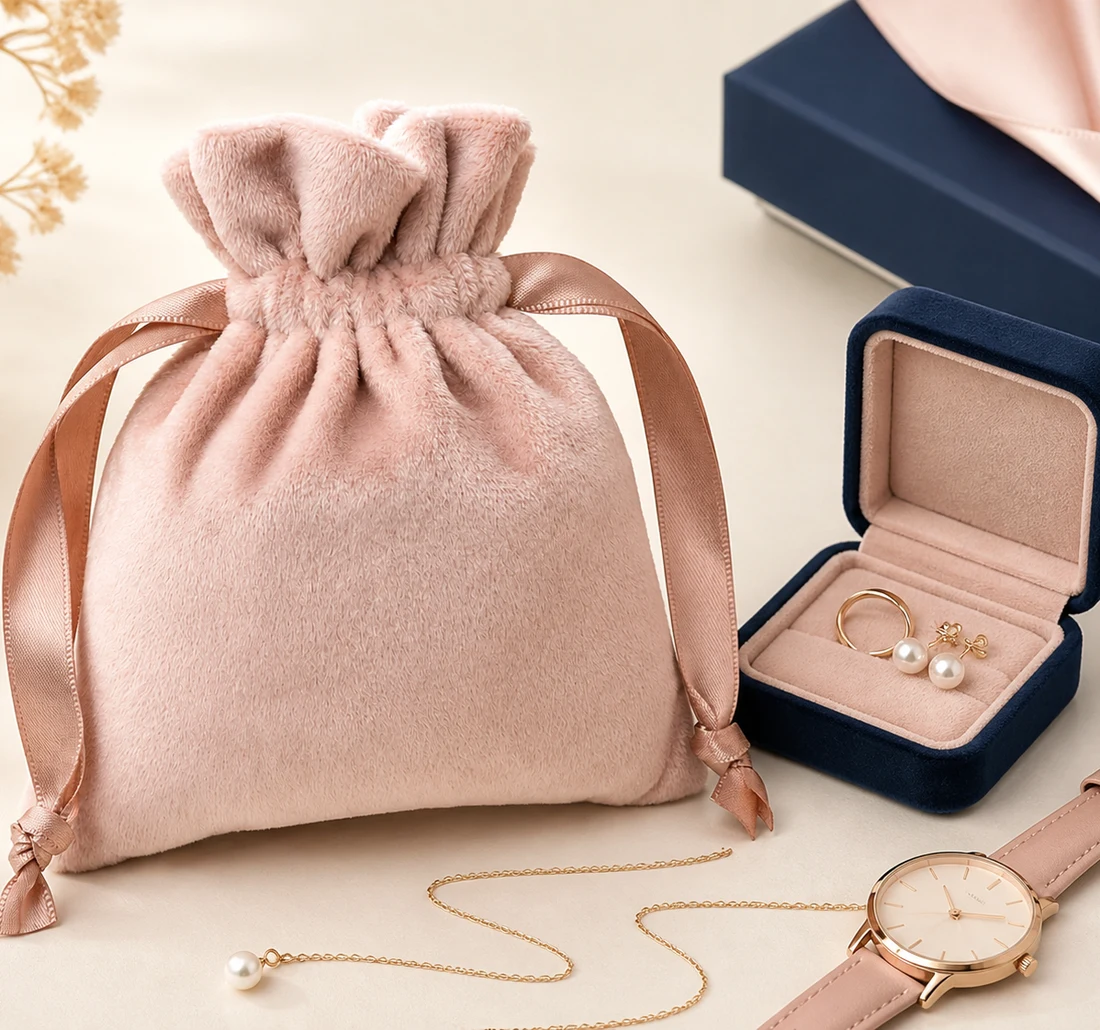
A good jewelry pouch is one the customer never has to think about: it does not shed onto the piece, does not scratch it, closes properly, keeps its logo, fits the item and matches the last order. Most quality problems show up on the physical sample if you know where to look. This checklist covers the seven that come up most often and how to test each one in seconds.
1. It sheds lint onto the jewelry
Fibres on a polished ring or a black pendant are the first thing a customer notices in an unboxing photo. Pile fabrics such as velvet are the most likely to shed, especially along cut edges; microfiber suede has a dense, low-lint surface, which is why it is widely used for fine jewelry and eyewear.
Check: press a strip of clear tape against the inside of the pouch and peel it off, then rub the inside face against a dark cloth. Loose fibres on either mean they will end up on the piece. Compare the Red Velvet-Look Drawstring Pouch (VEL-019) with the Microfiber Pouch and Drawer Box Set (MFB-001) if you are deciding between the two surfaces.
2. It scratches what it is meant to protect
The inside face touches the jewelry, not the outside. A soft outer fabric with a stiff inner seam, a sewn-in label or the back of a foil logo pressing inward can mark polished metal. A pouch that is far too large also lets pieces knock against each other inside.
Check: turn the sample inside out. Run a fingertip along the seams and the back of the logo area. Anything rough to the finger is rough to a polished surface. For delicate pieces, a smooth inner face such as the Microfiber-Look Jewelry Flap Pouch (JEW-002) reduces contact marks.
3. The drawstring does not hold
A drawstring is a working part. A cord that is too thin slips open; a channel that is too narrow jams; cord ends that are not sealed or knotted fray after a few uses.
Check: open and close the sample ten times. It should pull shut smoothly and stay shut when the pouch is shaken with the piece inside. Look at the cord ends. Compare closures in drawstring, zip and flap closures, or see the Drawstring Jewelry Pouch (JEW-021) as a drawstring reference.
4. The logo wears off
The logo method has to suit the fabric. Foil stamping bonds most reliably to dense, smooth fabrics such as microfiber suede and satin; on velvet it holds solid shapes better than fine lines, because thin strokes sink into the pile. Silk screen suits spot-colour logos on cotton and canvas.
Check: rub the logo firmly with your thumb twenty times, then fold the pouch across the logo and unfold it. Flaking, cracking or blurred edges will be worse after shipping. Read foil stamping on fabric and pouch printing methods compared before you finalise artwork.
5. The fit is wrong
A pouch that fits loosely looks cheap in photos; one that is too tight creases chains and is slow to pack. Fit should be judged on the piece as it is packed, including any card, insert or box.
Check: pack the real piece. There should be room to slide it in without forcing, and no more than a finger's width of slack around it. Long chains often need a long pouch rather than a wider one, such as the Long Fold-Over Necklace Pouch (JEW-020). The drawstring bag size calculator and the pouch size guide explain what to measure.
6. The colour drifts between orders
Velvet and other pile fabrics change shade with the direction of the nap and with lighting; dyed fabrics also vary between dye lots. A second order that looks different from the first is one of the most common complaints in repeat programs.
Check: approve colour on a physical swatch under your own lighting, not from a screen. Keep the approved sample and send it, or a photo of it beside the new swatch, with every reorder. Setting up a program you can reorder covers what to document.
7. Seams and edges come loose
Loose threads, uneven hems and raw edges that fray are small details that read as low quality. Corners and the top of the drawstring channel take the most stress.
Check: pull gently at each corner and along the channel. Trim threads should be clean; edges should be hemmed or bound so they do not fray. Look at several pouches from the sample batch, not just one.
A note on tarnish
A standard fabric pouch keeps dust and scratches off a piece, but it is not a tarnish-control product. If your silver pieces need tarnish protection, plan for it separately rather than expecting it from the pouch fabric.
The ten-second sample check
| Problem | Ten-second test | What a pass looks like |
|---|---|---|
| Lint | Tape on the inside face; rub on a dark cloth | No loose fibres |
| Scratching | Turn inside out; fingertip along seams and logo back | Nothing rough to the touch |
| Drawstring | Open and close 10 times; shake with the piece inside | Smooth pull, stays shut, ends sealed |
| Logo | 20 firm thumb rubs; fold across the logo | No flaking, cracking or blur |
| Fit | Pack the real piece with its card or insert | Slides in; about a finger's width of slack |
| Colour | Compare to the approved swatch under your lighting | Matches the reference |
| Seams | Gentle pull at corners and channel; check several pieces | No loose threads or fraying |
Plan the sample into your timeline
At Baishun Pack, physical samples take 3–7 days and bulk production typically takes 8–15 days after the sample is approved. The MOQ is 100 pcs including custom logo printing, and the unit price is quoted per specification. Run this checklist on the sample, write down the approved specification — fabric, colour, size, closure, logo method and position — and reorder against it. For the full pre-production list, see the pre-production sample checklist.
Starting points: Suede-Look Snap Jewelry Pouch (JEW-005), Satin-Look Drawstring Pouch (SAT-019), White Cotton Pouch with Teal Drawstring (COT-019), and the Drawer Jewelry Box and Pouch Set (BOX-001) for pieces that need a box. Browse all jewelry pouches, or send your specification for a sample quote.