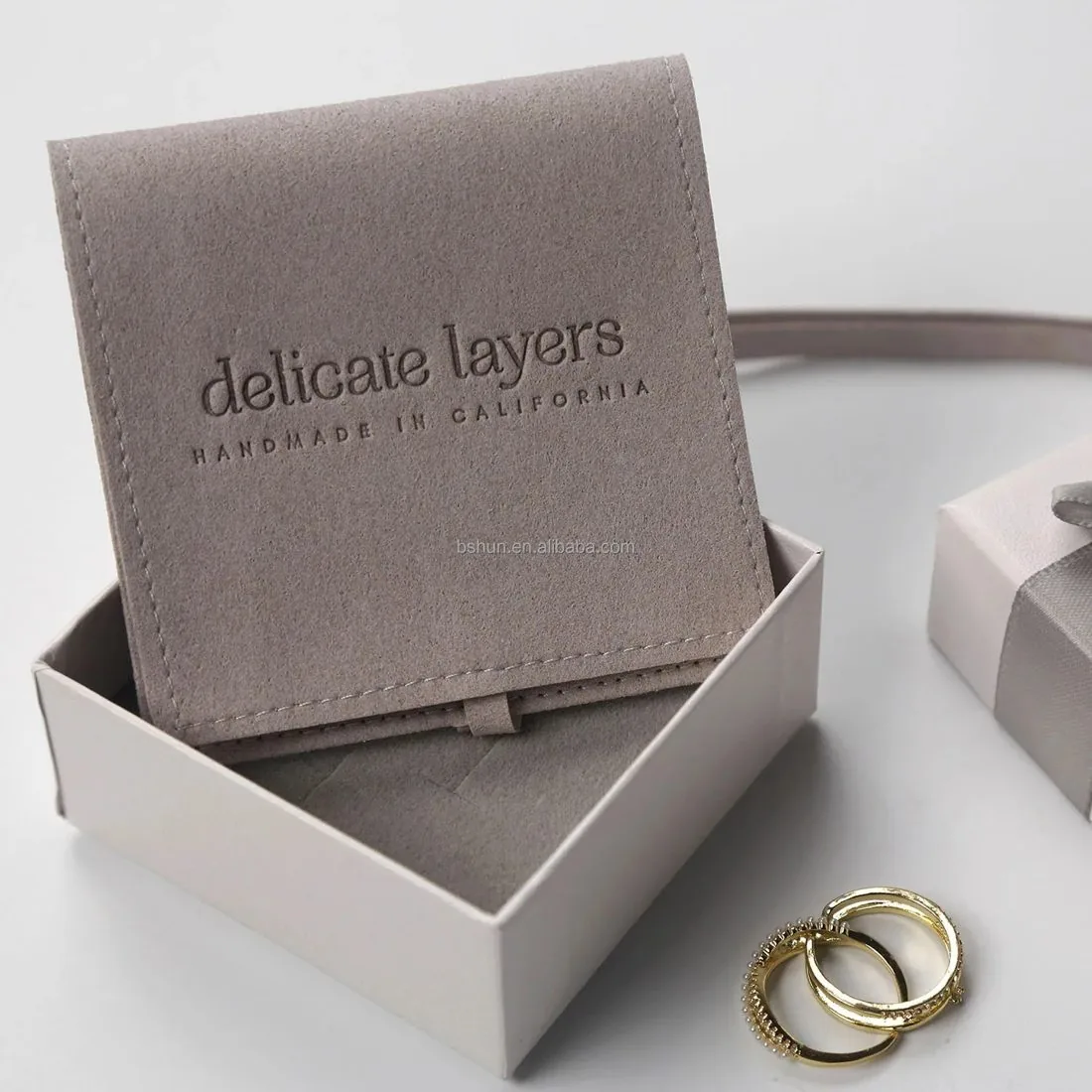
For a small brand, high minimum order quantities are the hardest part of custom packaging. Many suppliers start custom work at 1,000 units per design, which ties up cash in stock before the product has proven itself. These are the practical ways to get branded packaging in small runs without the packaging looking like a compromise.
1. Customise the pouch, keep the box stock
Rigid printed boxes are expensive in small quantities. A fabric pouch is not: Baishun Pack's MOQ is 100 pcs including custom logo printing. Put the brand on the pouch, use a plain stock box or mailer around it, and the customer still opens something branded. For pieces that need a box, the Drawer Jewelry Box and Pouch Set (BOX-001) pairs a drawer box with a pouch so the set looks finished.
2. Choose fabrics that take your logo easily
Some fabric and logo combinations are simpler to produce well, which helps on small runs. Foil stamping bonds reliably to dense, smooth fabrics such as microfiber suede and satin; silk screen suits spot-colour logos on cotton and canvas. A simple one-colour mark on a suitable fabric is the most dependable route. See pouch printing methods compared.
3. Keep the size range small
Each pouch size is a separate specification. Covering your range with two or three sizes keeps each run meaningful and simplifies stock. Size from the piece as packed — the pouch size guide and the drawstring bag size calculator help.
4. Ask how the minimum applies across colours
If you need several colours, tell the supplier the split before quoting. How a minimum applies across colours and sizes varies, and it is better to know up front than after sampling. Send the colour split with your enquiry and it is confirmed with the quote.
5. Keep the parcel light and small
Packaging adds shipping cost by volume as much as by weight. A soft pouch inside a slim mailer is lighter and smaller than a padded box, which matters when couriers charge by volumetric weight. A microfiber pouch such as the Microfiber Pouch and Drawer Box Set (MFB-001) or a flat envelope pouch protects the piece from scratches and dust without bulk. For sea shipments of the pouches themselves, see sea freight vs. air for packaging orders.
6. Sample first, then lock the specification
Physical samples take 3–7 days. Approve fabric, colour, size, logo position and closure on the sample, and write the specification down. Bulk production typically takes 8–15 days after approval. A written specification is what makes the second order match the first — see what actually sets the MOQ for how the minimum and the specification are linked.
7. Plan the second order on day one
A low-MOQ first order is a test. If it sells, the second order is usually larger and needed faster. Agree at the start which details stay fixed — fabric, colour, size, logo artwork and position — so the reorder can go straight to production against the approved sample. Track how quickly the first 100 pcs are used, and reorder while stock still covers the 8–15 day production window plus shipping. Moving up in quantity once the design has proven itself is the practical way to bring the unit price down without taking the risk up front.
Summary
- Brand the pouch (MOQ 100 pcs including logo); keep boxes and mailers stock.
- Pick a fabric and logo method that suit each other.
- Cover the range with few sizes; confirm the colour split up front.
- Keep parcels light; sample before bulk; save the specification.
Browse jewelry pouches, microfiber pouches and cotton pouches, or get a low-MOQ quote.