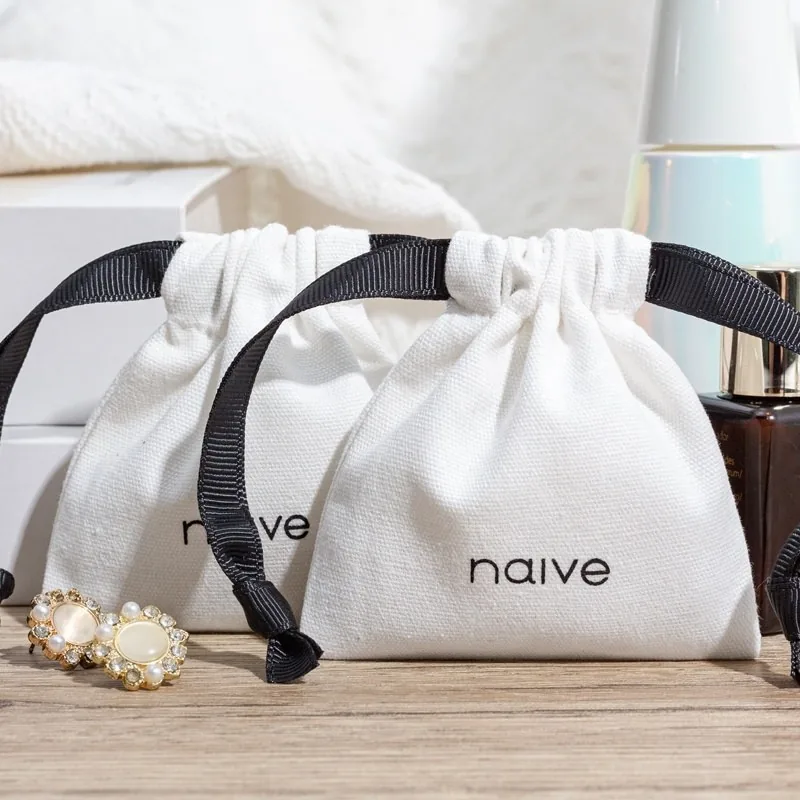
A label is often the only branded element on an otherwise plain pouch, which makes it disproportionately important to how the packaging reads.
Woven labels
The design is woven into the label as thread rather than printed onto it. The result has texture, does not crack or fade with handling, and reads as apparel-grade quality.
Detail resolution is limited by thread thickness, so very fine artwork and small type do not reproduce well. Gradients are not possible. Setup involves creating the weave pattern, which is a one-time cost, and colour count affects it.
Woven labels are the right answer when the brand mark is simple, when the pouch is otherwise plain, and when the packaging is meant to be kept.
Printed labels
Artwork printed onto a label tape or fabric. Handles fine detail, small type and complex or multi-colour artwork that a woven label cannot.
The trade-off is durability and feel. A printed label is flatter to the touch and will show wear before a woven one does. For packaging opened a few times this is irrelevant; for a pouch used daily it shows.
Direct decoration instead of a label
Foil stamping, deboss, screen printing and embroidery all put the mark directly on the pouch and avoid the label entirely. This usually looks more considered — the brand is part of the object rather than attached to it — and it removes an assembly step.
A label makes more sense when you need care or content information, when the same label is used across several products, or when the pouch fabric will not take the decoration method you want.
Placement
Whichever you choose, decide placement before sampling. A label sewn into a side seam, applied to the face, or attached inside are three different constructions, not three positions of the same construction. Changing placement after the first sample means re-sampling.
What to send
Vector artwork, the finished label dimensions, the attachment method and position, and colour references. For woven labels, expect to simplify — send the artwork and ask which elements will not hold at that size before committing.